Non-inductive Wirewound Resistors (KNPN)
Wirewound Non-inductive Resistors (KNPN) Introduction
Non-inductive Wire Wound Resistor Improves Inductance for High Frequency Applications.
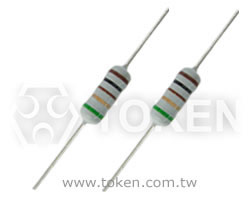
Token Electronics has introduced a non-inductive version KNPN resistor of conformal coated, leaded wirewounds. The KNPN non-inductive wire wound resistor offers the expected performance with the added characteristic of vastly improved inductance, making it suitable for high-switching applications.
Wirewound technology has long been known as a leading technology for power resistor needs though it is inherently inductive. Known as Ayrton Perry winding, a non-inductively wound has one winding in one direction and one in the other direction.
By using a non-inductively wound version this greatly reduces the inductance of any given resistor size and value combination; however, it does not completely eliminate the inductance.
This non-inductive winding is available in all standard KNPN sizes from 0.5 watts up to 6 watts with options 1%, 2% and 5% tolerance. The KNPN series is RoHS compliant and also can be supplied with radial, goalpost or lancet preformed leads.
To address your need for technical and economic success in a timely manner, our custom solutions are available. Contact us with your specific needs.
Download complete specification - Non-inductive Wirewound Resistors (KNPN).
- Operating temperature range -55°C ~ 155°C.
- Products with Pb-free Terminations and RoHS compliant.
- Low cost, Excellent pulse load capability, Non-inductive Ayrton Perry winding.
- A wide resistance range 0.1Ω to 50Ω, A wide range of power ratings 0.5W to 6W.
- Home Entertainment, Appliances.
- High Voltage Applications, High-Switching Applications.
- Welders, Power Supplies, Power Tools, Current Sensing, Consumer Applications.
(KNPN) Specifications & Dimensions
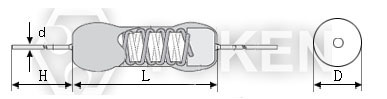
(KNPN) Dimensions |
||||||||
| Type | Rated Watts | Dimensions (Unit: mm) | Resistance Range (Ω) | Tolerance | ||||
| D ± 0.5 | L ± 1 | H ± 3 | d ± 0.05 | |||||
| KNPN | KNPN-50 | 1/2W | 4 | 9.0 | 26 | 0.50~0.55 | 0.1-10 Ω | ± 1% ± 2% ± 5% |
| KNPN-100 | 1W | 4 | 9.0 | 26 | 0.50~0.55 | 0.1-10 Ω | ||
| KNPN-100B | 1W | 4.5 | 11.5 | 26 | 0.75~0.80 | 0.1-10 Ω | ||
| KNPN-200 | 2W | 4.5 | 11.5 | 26 | 0.75~0.80 | 0.1-10 Ω | ||
| KNPN-200B | 2W | 5.5 | 15.5 | 35 | 0.75~0.80 | 0.1-20 Ω | ||
| KNPN-300 | 3W | 5.5 | 15.5 | 35 | 0.75~0.80 | 0.1-20 Ω | ||
| KNPN-400 | 4W | 6.5 | 17.5 | 35 | 0.75~0.80 | 0.1-30 Ω | ||
| KNPN-500 | 5W | 6.5 | 17.5 | 35 | 0.75~0.80 | 0.1-30 Ω | ||
| KNPN-500B | 5W | 8.5 | 24.5 | 38 | 0.75~0.80 | 0.1-50 Ω | ||
| KNPN-600 | 6W | 8.5 | 24.5 | 38 | 0.75~0.80 | 0.1-50 Ω | ||
Electrical Performance (KNPN)

(KNPN) Power derating curve |
||||||||
| TEST ITEMS | CONDITION | SPEC | ||||||
| Operating Temperature Range |
-55 °C ~ 275 °C (0W) | |||||||
| Resistance Temp. Coeff. |
Room temperature/100 °C up | ± 300 PPM / °C | ||||||
| Short Time Overload | 10 times of rated wattage for 5 sec. | ± 2 % | ||||||
| Rated Load | Rated wattage 30 min. | ± 1 % | ||||||
| Voltage Withstanding | 500VAC 1 min | ± 1 % | ||||||
| Temperature Cycling | -20 °C ~ 85 °C 5 cycles | ± 1 % | ||||||
Application Notes of Non-inductive Wire Wounds (KNPN)
- When being used in AC circuits, some wirewound structures give inductance ingredients or parasitic capacity, so they may cause unusual phenomena such as oscillations etc.
Quorum deviations of other components should be carefully taken into account for use. - Application and Placement: Wire wound resistors use different gauges of wire as resistance elements.
Sometimes the gauge is extremely thin (finer than a strand of human hair) and very susceptible to breakage in environments containing salts, ash, dust and corrosives. Avoid utilization in such environments. - Do not install in dusty areas because the accumulation will cause shorts and poor conductance.
Order Codes (KNPN)
| KNP-200 | 10R | J | P | ||||||||||||||||||||||||||||||||||||||||||||||||
 |
|
|
|
||||||||||||||||||||||||||||||||||||||||||||||||
|
|
|
|
||||||||||||||||||||||||||||||||||||||||||||||||